

Festival
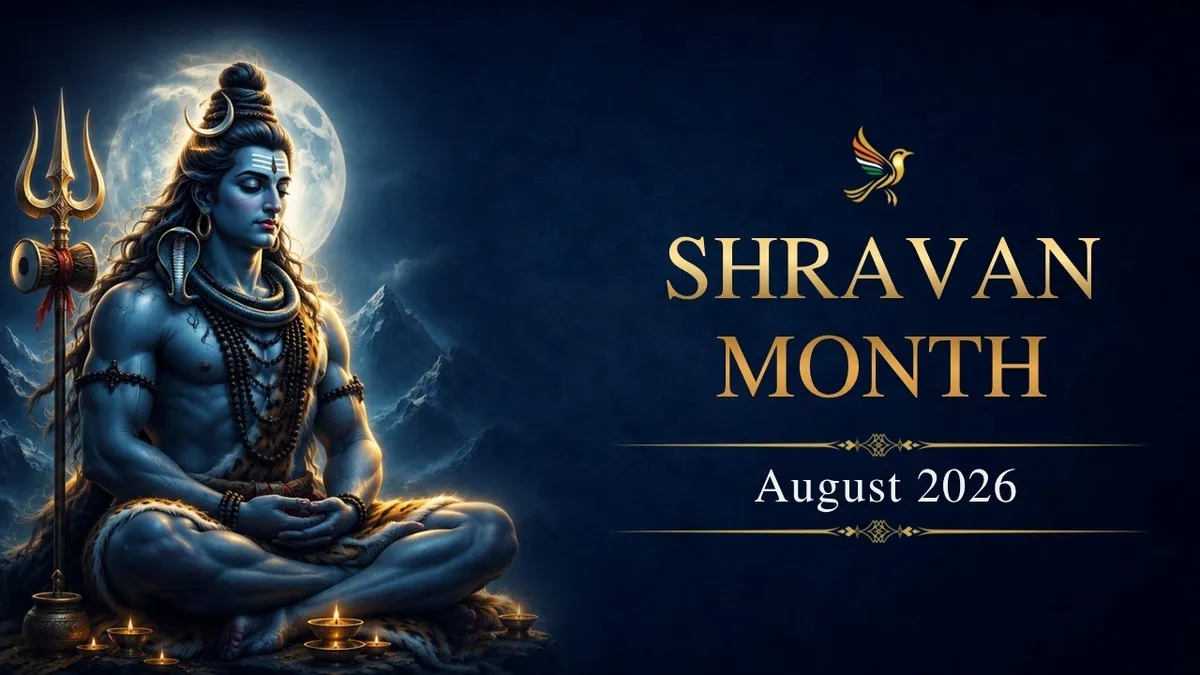
Shravan Month 2026: Rituals & Spiritual Significance
The monsoon clouds gather, the earth turns green again, and across India millions of devotees prepare for Shravan, the month closest to Bhagwan Shiva's heart. If you are observing Shravan for the first time, or continuing a tradition your family has kept for generations, this content piece walks you through everything you need to know about this sacred period.
Sanatan Sansaar|30 July 2026|5 min read|
What is Shravan Month?
Shravan, also called Sawan, is the fifth month of the Hindu lunar calendar. It usually falls between mid-July and mid-August, right in the heart of the monsoon. The month takes its name from the Shravan Nakshatra, a star constellation that rises during this time.
Hindu months are counted differently from the Gregorian calendar most of us use for daily life. They follow the moon, not the sun, and begin either after a new moon or a full moon depending on the region. North India generally follows the Purnimant system, where the month starts after the full moon. South India follows the Amavasyant system, where it starts after the new moon. This is simply why you may hear two different start dates for Shravan from friends or family in different parts of the country.
Shravan 2026 Dates
Shravan 2026 begins on Thursday, July 30, 2026, and ends on Friday, August 28, 2026, according to the North Indian Purnimant calendar. Devotees following the South Indian Amavasyant calendar will begin roughly two weeks after, around August 13, and conclude around September 11. If you are unsure which calendar your family follows, your local panchang or family priest can confirm this for you.
Shravan Somwar Dates 2026
Every Monday in this month carries special weight, since "Som" itself means moon, and the moon rests on Shiva's head.
- First Somwar: August 3, 2026
- Second Somwar: August 10, 2026
- Third Somwar: August 17, 2026
- Fourth Somwar: August 24, 2026
Why is Bhagwan Shiv Worshipped During Shravan?
To understand the reason behind this, we have to go back to one of the most powerful stories in Hindu scripture: the Samudra Manthan, the churning of the cosmic ocean.
During the churning of the ocean by the Devas and Asuras, many divine things emerged from the sea. But before Amrit (nectar of immortality) appeared, a deadly poison called “Halahal” came out of the ocean. It was so powerful that it could have easily destroyed the entire universe. There was panic everywhere. No one, not even the gods, knew how to stop it.
To protect every living being, Mahadev stepped forward and consumed the poison without thinking about himself. When Maa Parvati saw this, and fearing that the poison would reach his heart, she gently held Bhagwan Shiv’s throat. Because of this, Bhagwan Shiv’s throat turned blue, and from that day onwards, he also came to be known as Neelkanth.
This act of sacrifice happened during Shravan. Ever since, devotees have set aside this entire month to worship Bhagwan Shiv with gratitude.
What is the Significance of Shravan Month?
Ancient texts, including the Shiv Purana, describe Shravan as the most auspicious time of the year to seek Bhagwan Shiv's blessings. Prayers offered during this month are believed to reach him with far greater power than at other times. Think of it like the difference between writing a letter and having a face to face conversation. That is how close devotees feel to Mahadev during Shravan.
Somwar holds a special place within this month too. Fasting on a Shravan Somwar is believed to remove obstacles, bring peace of mind, protect the family, and for many unmarried women, help bring a suitable life partner. Married couples often keep this fast together, praying for a strong and harmonious bond.
What Devotees Do During Shravan Month?
Across the country, this devotion takes different shapes. Up north, the Kanwar Yatra takes over the roads, with pilgrims carrying holy Ganga water on their shoulders all the way to their local Bhagwan Shiv temple. Bihar and Jharkhand do it differently, whole villages come together and perform group pujas instead. Head south, and the month feels quieter altogether, families mostly pray at home rather than joining big public processions. In Gujarat and Maharashtra, Shravan overlaps with Janmashtami preparations, so the season picks up its own regional flavour there.
Within homes too, the month brings its own rhythm. Many devotees visit Bhagwan Shiv temple on Somwar, offer bilva leaves and milk at the Shivling. Some devotees also perform Shiv Rudrabhishek puja and chant “Om Namah Shivaya,” recite Shiv Chalisa or Mahamrityunjaya Mantra, and listen to Shiv bhajans.
Shravan Puja Vidhi
- Begin the day early with a bath and by wearing clean clothes.
- Clean and prepare the puja area
- Take a pinch of rice and a coin in your right palm and set your sankalp, stating your name, your gotra, and your intention for this puja
- Pour clean water over Shivling while chanting “Om Namah Shivaya”
- Pour panchamrit (mixture of milk, curd, honey, ghee, and sugar) over the Shivling
- Now, pour fresh milk and then rinse the Shivling with Ganga jal (if not available, use clean water)
- Light a diya and apply sandalwood paste and offer fresh flowers, placing bilva leaves in sets of three
- Recite Mahamrityunjaya Mantra
- Pray to Mahadev for peace, prosperity, and happiness in life
- End the puja with aarti and charity
FAQs
Can I perform Shravan puja at home without visiting a temple?
Yes. If you are unable to visit a Shiv temple because of any medical or personal reason, you can worship Bhagwan Shiv at home.
When does Shravan month start in 2026?
For those following the North Indian Purnimant calendar, Shravan begins on 30 July 2026 and runs till 28 August 2026. If your family follows the South Indian Amavasyant calendar, it starts later, around 13 August, and wraps up by 11 September 2026.
How many Mondays fall in Shravan 2026?
There are four Somwars this year, falling on 3, 10, 17, and 24 August.
Where can I get original Ganga Jal and puja items for Shravan month?
Many devotees prefer trusted platforms such as Sanatan Sansaar to buy the necessary items, such as Ganga Jal, diyas, incense, bel patra, and other sacred items needed for Shravan month.