

Festival
The Bhagavad Gita & Freedom Fighters
India's Independence Day is observed every year on August 15 to remember the day India became free from British rule. Behind this freedom were the courage, sacrifice, and determination of countless freedom fighters. For many of them, the Bhagavad Gita was more than a sacred text. Its teachings gave them strength to face fear, hardship, imprisonment, and even death.
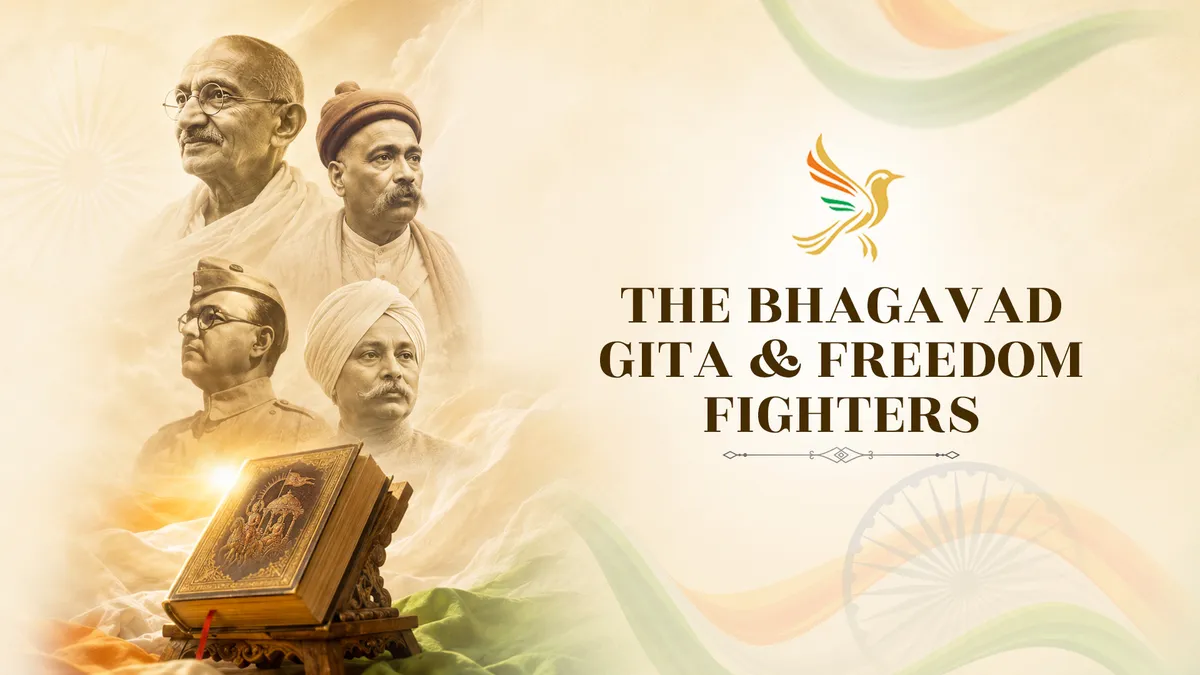
The Gita did not inspire every freedom fighter in the same way. For some it was a guide to selfless action, while others found in it the courage to stand against injustice. Important personalities/leaders like Mahatma Gandhi, Bal Gangadhar Tilak, Sri Aurobindo, and Subhash Chandra Bose were greatly inspired by it. Moreover, many young revolutionaries found courage in its verses.
Sanatan Sansaar|13 August 2026|2 min read|
How Did the Bhagavad Gita Inspire India's Freedom Fighters?
Many freedom fighters held onto one simple idea from the Gita: do your duty, don't worry about what comes of it. Bhagwan Krishna tells Arjuna in the Gita, “Karmanye vadhikaraste ma phaleshu kadachana.” You have a right to your work, not to its results.
Gandhi took this to heart. So did Tilak. Both leaned on the idea of Nishkama Karma, acting without attachment to outcome. It gave them a reason to keep going even when personal gain looked unlikely, or when failure seemed possible. They acted because it felt right, not because of what they'd get out of it.
The Gita also says the soul never dies. “Na jayate mriyate va kadachin,” Krishna tells Arjuna, the soul is never born, never destroyed. For men and women facing prison, violence, even death, this mattered a great deal. If the body wasn't really what defined them, then maybe death wasn't something to fear so much. Their duty stayed the priority.
There's a moment in the Gita where Krishna pushes Arjuna to stop hesitating and act. “Tasmat uttishtha kaunteya yuddhaya kritanishchayah,” he says. Rise up, fight, whatever comes of it, victory or death.
The emphasis that each leader derived from these lessons was unique to them. For Gandhi, it was anasakti, selfless activity, which formed the foundation of his Satyagraha and nonviolence philosophy. For Tilak, Karma Yoga was a direct call to stay active and engaged.
Each leader took something slightly different from these teachings. Gandhi leaned on the idea of Anasakti, selfless action, and built his path of Satyagraha and non-violence around it. Tilak read Karma Yoga as a direct call to stay active and engaged. Sri Aurobindo took a spiritual path and used the Gita as a guide for inner growth. He believed that real freedom for the nation had to start with spiritual awakening. Netaji Subhas Chandra Bose was always action-oriented and used the lessons of courage and sacrifice of Gita to keep going in the struggle for India’s freedom.