

Loading…
Festival
Dev Uthani Ekadashi 2026: Date, Parana Time, Vrat Katha, Puja Vidhi & Tulsi Vivah
Sanatan Sansaar|19 नवंबर 2026|11 मिनट पढ़ें|
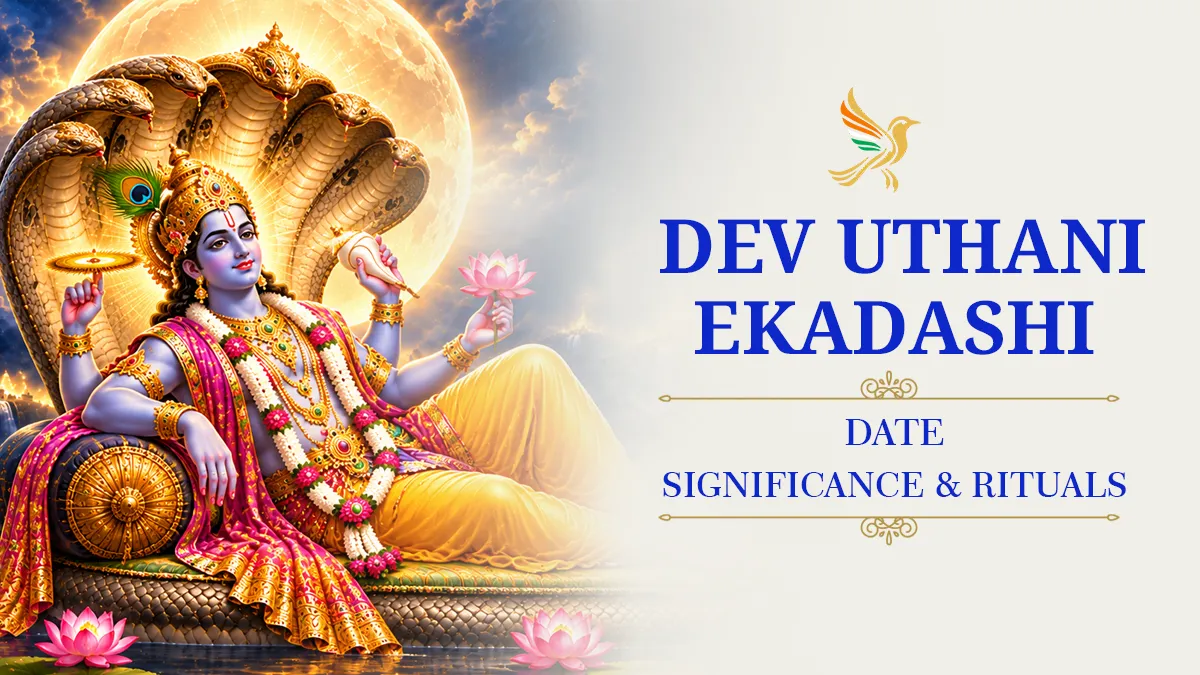
For four long months, the world waits quietly. Weddings pause, new beginnings are held back, and homes follow a simpler, slower rhythm. And then one morning in the month of Kartik, a drumbeat of devotion rings out across the country, and families sing a sweet, simple song to wake a sleeping God.
That day is Dev Uthani Ekadashi, the festival of the awakening of Lord Vishnu. It is also called Devuthani Ekadashi, Devutthana Ekadashi, Prabodhini Ekadashi, Dev Prabodhini Ekadashi, Haribodhini Ekadashi and Dev Uthni Gyaras, and many people also search for it as Devduta Ekadashi. It marks the end of Chaturmas, the beginning of the wedding season, and the joyful celebration of Tulsi Vivah.
In this guide, you will find the Dev Uthani Ekadashi 2026 date, tithi and parana time, the vrat katha, the complete puja vidhi, Tulsi Vivah rituals, fasting rules, regional traditions and simple remedies, all in easy, clear language.
Dev Uthani Ekadashi 2026 Date and Time
Dev Uthani Ekadashi takes place on the Kartik Shukla Ekadashi tithi that is the eleventh day of the bright half of Kartik. For 2026, the Ekadashi tithi falls on two days; therefore, you will find the dates for the same in two separate Panchangs.
| Detail | Dev Uthani Ekadashi 2026 |
| Dev Uthani Ekadashi (Smarta) | Friday, 20 November 2026 |
| Vaishnava Dev Uthani Ekadashi | Saturday, 21 November 2026 |
| Ekadashi tithi begins (approx.) | Around 7:16 AM, 20 November 2026 |
| Ekadashi tithi ends (approx.) | Around 6:30 AM, 21 November 2026 |
| Parana for Smarta fast | 21 November 2026, after Hari Vasara ends around midday (approx. early afternoon) |
| Parana for Vaishnava fast | 22 November 2026, just after sunrise (approx. 6:46 AM) |
| Tulsi Vivah | Evening of Ekadashi or on Dwadashi, commonly 20 or 21 November 2026 |
| Followed by | Kartik Purnima (Dev Diwali), 24 November 2026 |
Please remember: The timing of the tithi and parana depends on your city’s Sunrise and Panchang followed by you. The majority of people keep the fast on Friday, 20 November. Those people following the Vaishnav sampradaya like ISKCON, Vallabh and others keep the fast on Saturday, 21 November. There are some sources giving the date 19 November also.
What Is Dev Uthani Ekadashi?
According to the Puranas, Lord Vishnu goes into a cosmic sleep (Yoga Nidra) on Devshayani Ekadashi in the month of Ashadha. These four months of the rainy season are known as Chaturmas. On Dev Uthani Ekadashi, he wakes up, and the whole creation wakes up with him.
That is why this Ekadashi is also called Prabodhini, which means "the awakening." It is one of the most joyful Ekadashis of the year, because it brings back all auspicious activities that were paused during Chaturmas.
Why Is Dev Uthani Ekadashi Important?
Lord Vishnu awakens. It is a special day marking the awakening of Lord Vishnu from his four-month sleep and the revival of divinity in the world.
Chaturmas come to an end. The time period of austerity, fasting, and abstinence ends.
Wedding Season Begins. Marriage ceremonies, engagements, griha pravesh and other auspicious events begin post this day.
Tulsi Vivah occurs. The holy ceremony of marrying Tulsi and Shaligram (Lord Vishnu) takes place.
This is an extremely strong Ekadashi. Observing fast and praying on this particular day is considered to wash away all sins and lead to salvation in Vaikuntha.
Auspicious blessings for the whole family. On this day, many families pray for the well-being of their entire families.
Dev Uthani Ekadashi Vrat Katha
Dev Uthani Ekadashi is associated with two lovely and very famous stories.
Lord Vishnu’s wake-up time
According to mythology, it is believed that upon the request of Goddess Lakshmi, who thought that Lord Vishnu worked continuously and never got any rest, Vishnu promised to take a four-month long sleep every year during the rainy season. Four months’ sleep period came to be known as Chaturmas. He sleeps on Devshayani Ekadashi and wakes up on Dev Uthani Ekadashi.
Story of Vrinda and Tulsi Vivah
The second story is about Vrinda, the devoted wife of the demon king Jalandhar. The purity and devotion of Vrinda made Jalandhar near invincible. In order to bring balance in the world, Lord Vishnu assumed a form which broke the vow of Vrinda and Jalandhar was destroyed.
When Vrinda came to know of the truth, she was shattered and cursed Lord Vishnu to become a stone which is now called Shaligram. Pleased with her devotion, Lord Vishnu granted blessings to Vrinda who later became the holy Tulsi plant and pledged to accept Vrinda in the form of Shaligram every year.
That is why, the marriage of Tulsi and Shaligram is celebrated as Tulsi Vivah on Dev Uthani Ekadashi and the following days.
Message of the Katha: Devotion, purity and faith will always be rewarded by the divine and an ending may just be the beginning of a new blessing.
Dev Uthani Ekadashi Puja Vidhi (Step by Step)
This is the simplest way to conduct puja at your own house.
Get up early and take a bath. Take a bath in the morning, wearing clean clothes, especially yellow or white colored clothing.
Take the sankalp. Hold water in your right hand and vow that you would observe Dev Uthani Ekadashi Vrat with all devotion and dedication.
Clean and decorate the place where puja is to be done. Prepare a rangoli at the entrance and also prepare the footprints of Lord Vishnu in rice powder, if you follow this practice.
Set up the altar. Place the idol or picture of Lord Vishnu and goddess Lakshmi or Shaligram in a clean place. Also light ghee deepak and dhoop.
Puja items to be offered. Yellow flowers, leaves of Tulsi, roli, akshat, sandalwood paste and fruits including sugar cane and sweets.
Wake up the Lord. Ring the bell, blow a conch, clap, and sing the following traditional mantras to awaken Lord Vishnu: "Uthho Dev, Baitho Dev, Angurriya Chatkao Dev". This marks the core ritual of the festival.
Recite the mantras. Recite the mantras dedicated to Vishnu, along with recitation of the Dev Uthani Ekadashi katha.
Offer the aarti. Offer the aarti to Lord Vishnu and Goddess Lakshmi and distribute the prasad amongst the family members.
Light the lamps. Light the diya lamps inside the house as well as at the Tulsi plant and entrance.
Remain devoted throughout the day. Pass the day meditating, offering prayers, japa, bhajan or reading the religious texts.
Powerful Mantras for Dev Uthani Ekadashi
ॐ नमो भगवते वासुदेवाय (Om Namo Bhagavate Vasudevaya)
ॐ नमो नारायणाय (Om Namo Narayanaya)
श्री विष्णु सहस्रनाम (Vishnu Sahasranama)
ॐ श्रीं ह्रीं श्रीं कमले कमलालये प्रसीद प्रसीद (Lakshmi mantra)
Chant each mantra 11, 21 or 108 times with a rosary for the best focus.
Tulsi Vivah: The Sacred Wedding of Tulsi and Shaligram
Tulsi Vivah is the most popular ritual that is performed during the Dev Uthani Ekadashi. The ritual can be carried out either in the evening of the day of Ekadashi or on the day of Dwadashi, based on the traditions of the families. Some families take it seriously as a marriage ceremony.
How to Perform Tulsi Vivah at Home
Preparing the Tulsi plant. The Tulsi plant must be cleaned thoroughly along with its pot. Decorate the plant like a bride using a red chunri (dupatta), bangles, bindi, sindoor and flowers.
Preparing the mandap. Set up a small canopy for the ceremony using sugarcane sticks, flowers and a rangoli.
Placing Shaligram/Vishnu. Put a Shaligram stone or an idol/ photo of Lord Vishnu or Krishna beside the Tulsi plant wearing yellow clothes.
Performing the puja. Give roli, akshat, haldi, flowers, fruits, sugarcane, sweets and lamps to both of them.
Performing the marriage rituals. Tie a sacred thread connecting both and perform here seven times and sing wedding songs. In some families, there is a ritual of chanting mantras with a pandit.
Offering bhog. Seasonal fruits like amla, ber, singhara, sweet potato and sugarcane and sweets must be offered.
Performing the aarti. Perform the aarti of Tulsi and Vishnu and give out the prasad.
Tulsi Vivah Samagri List
Tulsi plant and a clean pot
Shaligram, or an idol or picture of Lord Vishnu or Krishna
Sugarcane stalks for the mandap
Red chunri, bangles, bindi, sindoor, mehendi and other shringar items
Haldi, roli, akshat and sandalwood paste
Flowers, garlands and mango leaves
Ghee lamp, incense and camphor
Seasonal fruits: amla, ber, singhara, sweet potato, banana
Sweets and dry fruits
Sacred thread (mauli)
Dev Uthani Ekadashi Fasting Rules (Vrat Niyam)
Fasting is observed by devotees considering their physical condition and customs.
Nirjala vrat - No food and water; for experienced and healthy persons.
Phalahar vrat - Only fruits, milk, dry fruits and other allowed foods. It is the most popular kind of fasting.
One single satvik meal - A simple grain-free meal for those who cannot keep fasting.
Older people, children, pregnant ladies and persons with health problems do not have to keep any strict fasting, and they should adhere to medical recommendations.
What to Eat on Dev Uthani Ekadashi
Fruits, nuts and dry fruits
Milk, curd, buttermilk and paneer
Sabudana, kuttu (buckwheat), singhara and samak rice
Potato, sweet potato and other permitted vegetables
Rock salt (sendha namak) instead of regular salt
Seasonal winter produce such as sugarcane, amla and ber, as offered in the puja
What to Avoid on Dev Uthani Ekadashi
Rice, wheat, pulses, lentils and other grains
Regular salt, onion and garlic
Non-vegetarian food and alcohol
Anger, gossip, lying and harsh speech
Sleeping during the day
Plucking tulsi leaves on Ekadashi (collect them a day before)
Dev Uthani Ekadashi Parana Rules (How to Break the Fast)
Breaking the fast in an appropriate way will only make the fast complete.
The fasting ends on Dwadashi which is after one day from Ekadashi.
Parana needs to be done after sunrise, within the window period of parana after the end of Ekadashi.
Hari Vasara needs to be avoided, and fasting ends only after this period.
Smartas will break their fast on 21st of November while Vaishnavas will break theirs on 22nd November after sunrise.
Fasting ends with prayers followed by some tulsi water or prasad, and then light eating.
Bhishma Panchak: The Five Days After Dev Uthani
The five-day period starting from Dev Uthani Ekadashi till Kartik Purnima is called Bhishma Panchak. Most people undertake a mild fast during this period, offer prayers to Lord Vishnu and do charity work. It is said to be very auspicious for spiritual activities.
Dev Uthani Ekadashi Traditions Across India
North India (UP, Bihar, Rajasthan, MP, Delhi): It is called Dev Uthani Gyaras and it is marked with the traditional awakening song, Tulsi Vivah and decoration with sugarcane.
Maharashtra: Celebrated as Kartiki Ekadashi, there is a famous pilgrimage to Pandharpur for the worship of Lord Vitthal.
Gujarat: Celebrated as Tulsi Vivah and temple visits.
Odisha and eastern India: Celebrated as Vishnu puja and Tulsi worship.
South India: It is celebrated as Prabodhini Ekadashi with the decoration of Vishnu temples and worship there.
All over the world: Hindu families in the USA, UK, Canada and Gulf celebrate it with temple visits and Bhajans and at home Tulsi Vivah.
Dev Uthani Ekadashi and the Wedding Season
Perhaps one of the most important aspects of Dev Uthani Ekadashi is that the auspicious dates for getting married are now available once again. In the course of Chaturmas, all marriages and mangal karya are stopped. However, after Dev Uthani, there can be many auspicious muhurtas for marriage throughout the winter.
In case you have planned your marriage, mehandi or griha pravesh, you must consult a pandit regarding the particular auspicious date.
Dev Uthani Ekadashi Do's and Don'ts
Do
Rise early and ensure that the household and mind are pure
Pray to Lord Vishnu with sugarcane, amla and seasonal fruits
Chant the awakening song with enthusiasm, as a family
Celebrate Tulsi Vivah with faith and decorations
Distribute the prasad to family members, neighbours and people in need
Break the fast at the appropriate time
Don't
Do not consume grains, onion and garlic on Ekadashi
Do not fight, lie or use foul language
Do not miss the opportunity for parana
Do not pluck the tulsi leaves on Ekadashi
Do not observe the fast if your health does not permit
अक्सर पूछे जाने वाले प्रश्न
When is Dev Uthani Ekadashi in 2026?
Dev Uthani Ekadashi in 2026 occurs on Friday, 20 November 2026 for most families (Smarta) while for those following the Vaishnava tradition on Saturday, 21 November 2026. Kindly refer to your local Panchang.
What is the parana time of Dev Uthani Ekadashi 2026?
For Smarta devotees, the fasting concludes on 21 November 2026 upon the conclusion of Hari Vasara in the middle of the day. While for the Vaishnava devotees, fasting concludes on 22 November 2026 shortly after sunrise. This may vary depending on your location.
Is Devduta Ekadashi the same as Dev Uthani Ekadashi?
Yes. Dev Uthani, Devuthani, Devutthana, Prabodhini and Haribodhini Ekadashi are the same festival but have different names. Some people search for this festival using the name Devduta Ekadashi.
Why do we celebrate Dev Uthani Ekadashi?
It celebrates the awakening of the lord Vishnu from his four-month long sleep (end of Chaturmas) as well as the beginning of the season when weddings occur. Tulsi Vivah also takes place on this occasion.