

Loading…
Festival
Why Is Jagannath Ji's Idol Considered Incomplete?
Sanatan Sansaar|15 July 2026|8 min read|
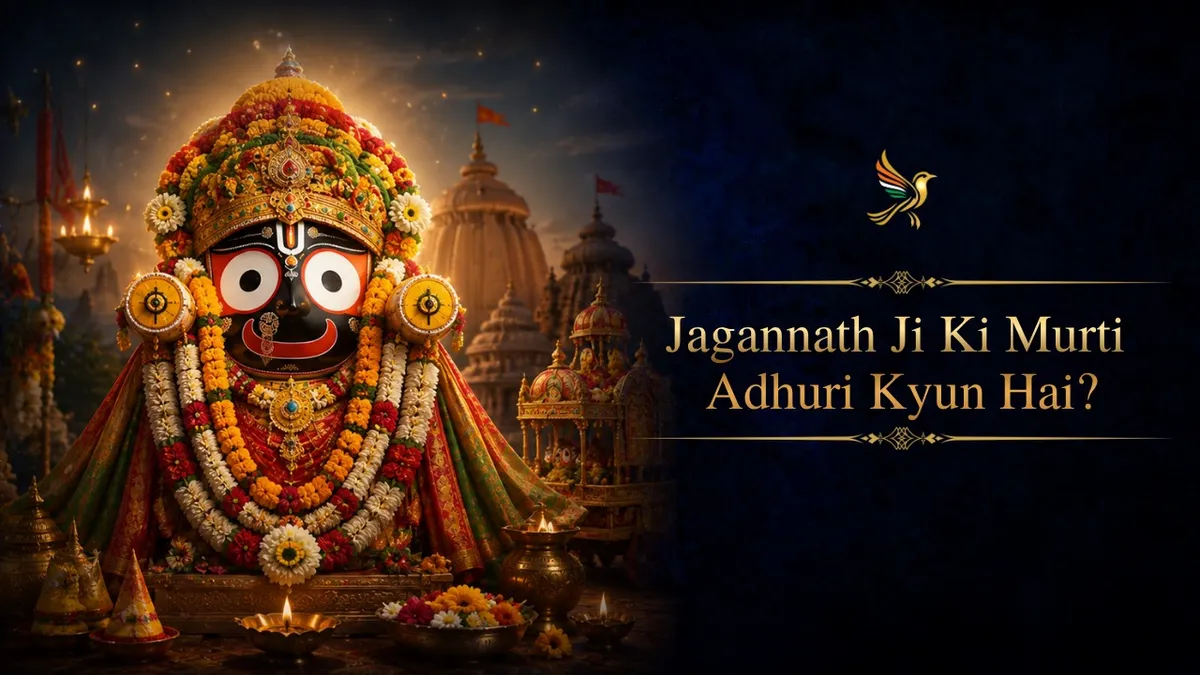
Every form of God carries a story behind it. Sometimes He appears as a child, drawing every heart towards Him effortlessly. Sometimes He reveals a cosmic form that leaves the mind speechless. And sometimes He appears in a way that makes you stop and ask, "What is this?"
The form of Jagannath Ji belongs to that third kind. In that great temple at Puri, when someone sees the idols of Bhagwan Jagannath, his elder brother Balbhadra Ji, and sister Subhadra Ji for the first time, they tend to stop. Large, wide eyes. A simple wooden form. Hands that are not fully shaped. A figure unlike any other deity's idol.
And then the question arises: why does this look incomplete? But those who see with eyes of devotion already know. This is not incomplete. This is Bhagwan's most divine, most loving, and most singular form. The form that the world calls incomplete from the outside, in that very form, devotees find Bhagwan's full grace, full compassion, and full love.
The Story of Raja Indradyumna and Neel Madhav
This is a very old story. And a very deep one. There was once a king named Indradyumna in Malwa. His devotion to Bhagwan Vishnu was not limited to prayer; he longed to have the divine darshan of Bhagwan. He heard about Neel Madhav. They said that form was mysterious and radiant, unlike anything known. The king sent his people to find him.
What emerged was this: Neel Madhav was being worshipped by a forest dweller and devotee named Vishwavasu. The form of Bhagwan was kept deeply secret. Ordinary people could not easily receive his darshan.
The king's devotion was genuine. He wished to bring Bhagwan into his kingdom so that all devotees could come and see him. It is said that Bhagwan himself gave the king a sign. He would appear on the seashore in the form of divine wood. That sacred wood came to be called Daru Brahma. With full faith and proper rites, the king received it and resolved that Bhagwan's idols would be carved from it.
Why Did Vishwakarma Ji Leave the Idols Incomplete?
Then one day, an elderly craftsman came to the king. Many traditions, that elderly craftsman is understood to be Vishwakarma Ji himself. He told the king, "I will make the idols." Jagannath, Balbhadra, and Subhadra Ji. But I have one condition. As long as I remain inside and do the work, no one will open the door. If the door is opened before the time, I will leave the work as it is and go. The king accepted. The craftsman entered the room. Sounds of carving could be heard from inside. Days passed. The king and queen waited outside.
And then one day, the sounds from inside stopped completely. The king grew anxious. Had something happened to the old craftsman? The queen became restless too. Torn between faith and anxiety, the king finally lost patience., and the king had the door opened before the time. The door opened. And what stood before them was extraordinary. The forms of Bhagwan Jagannath, Balbhadra, and Subhadra Ji were there. But the hands and feet were not shaped in the ordinary way. The eyes were very large. The form was unlike anything seen before.
The elderly craftsman had disappeared. The king understood his mistake. He felt that because of his impatience, the idols could not be completed.
Why Did Bhagwan Accept This Form?
This is where the story becomes most beautiful. Bhagwan accepted being installed in this very form. This was not a mistake. This was Bhagwan's divine will. He chose to live among his devotees in exactly this way, and this very form went on to become the symbol of Jagannath Ji, the Lord of the universe.
The greatest message of this entire story is that Bhagwan is not bound by any limited shape. Human beings search for completeness in outward form. But the completeness of God is understood through feeling, not through form.
The form of Jagannath Ji is telling us the ordinary shape of hands and feet is not necessary for Bhagavan. Without ordinary hands, he still accepts every devotee. Without ordinary feet, he still reaches every devotee. And with those vast eyes, he watches over the entire world—showering his grace upon every heart that turns to him.
What Do Jagannath Ji's Large Eyes Mean?
Those eyes speak a great deal. Jagannath Ji is watching over his devotees at every moment. In those eyes there is compassion, there is wakefulness, and there is the feeling of accepting everyone without distinction. He is not the God of one caste, one class, one language, or one place. He is the Lord of the entire world, which is why his door is open to every devotee, without exception. In some Vaishnava traditions, there is a feeling that is very beautiful.
When Bhagwan Krishna remembers the lilas of Vrindavan, the love of the gopis, he becomes so immersed in that divine love, so overwhelmed by that feeling, that his very form changes. His eyes widen, his limbs draw inward, and he appears as though completely lost in an ocean of love. Seen through this feeling, the form of Jagannath Ji is the form of Bhagwan melting in love.
The Significance of Rath Yatra and the Jagannath Feeling
The form of Bhagwan Jagannath does not stay within the walls of the temple. During Rath Yatra, he himself comes out. With his brother Balbhadra and sister Subhadra Ji, he rides upon a chariot and goes among his devotees.
This is a very profound thing. Bhagwan does not merely wait for devotees to come; he himself goes to them. This is the Jagannath feeling. Where Bhagwan embraces everyone, without any separation.
And this is what Jagannath Ji's form is teaching: to reach Bhagwan, external perfection is not what is needed. True feeling, true devotion, and true surrender—that alone is enough.
What Does the Nabakalebara Tradition Teach?
Jagannath Ji's idols are made of wood, and from time to time, according to the Nabakalebara tradition, a new form is established. This tradition too carries a very deep message. The body changes the divine essence does not change. The wooden form may change, but Bhagwan's feeling, his power, and his grace remain forever.
Nabakalebara also teaches us this about life: the external form can change, but the divine feeling within must remain. This is the depth of Sanatan. Form is changeable. Essence is eternal.
The Spiritual Message of This Story
When someone asks why Jagannath Ji's idol is incomplete, the answer lies not in the story but in the feeling. This is not an incomplete idol. This is Bhagwan's form that is saying, "I am not found through outward perfection." I am found through the love within.
Human beings see form. Bhagwan sees feeling. Human beings seek completeness in shape. Bhagwan shows completeness in love. In today's life, this story carries great importance. We run so much after outward success, position, appearances, and perfection that we forget the beauty within. Jagannath Ji reminds us that what appears incomplete from the outside can be divine and whole from the inside.
The Feeling Behind Sanatan Sansaar
This is what we try to do at Sanatan Sansaar. To understand the stories of Sanatan not merely as mysteries and miracles, but with their true feelings, their spiritual meaning, and the message they carry for daily life.
The story of Jagannath Ji's idol says exactly this: God is not bound by any limit. He appears fully in the devotee's faith, in their surrender and in their love. The form of Bhagwan Jagannath Ji says the same thing again and again—God is not known through outward shape. He is known through the feeling in the heart of the devotee.
A Final Word
Bhagwan Jagannath Ji's idol is not incomplete. It is Bhagwan's extraordinary form that is telling us God is beyond body, beyond shape, beyond limitation. He appears in the love of the devotee; he lives in the devotee's faith, and he dwells in every heart that calls to him with true feeling. This is the greatest mystery of Jagannath Ji's idol and its most beautiful message too.
FAQs
Why is Jagannath Ji's idol considered incomplete?
According to the folk story, the door was opened before time during the making of the idols, which is why the idols did not appear in the ordinary complete form. But in the spirit of devotion, this form is not considered incomplete; it is understood as Bhagwan's divine and singular form.
Who is believed to have made Jagannath Ji's idol?
According to many traditions, an elderly craftsman came to make the idols, who is understood to have been Vishwakarma Ji himself.
Who was Raja Indradyumna?
Raja Indradyumna is regarded as a great devotee of Bhagwan Vishnu. Wanting to have the darshan of Neel Madhav, he took a resolve to establish Bhagwan at Puri.
What is Daru Brahma?
Daru Brahma refers to the sacred wood from which the wooden forms of Bhagwan Jagannath, Balbhadra, and Subhadra Ji were made.
Why are Jagannath Ji's eyes so large?
Jagannath Ji's vast eyes are considered a symbol of Bhagwan's grace upon his devotees, his compassion, and his feeling of accepting everyone without distinction.
Is Jagannath Ji's idol truly incomplete?
No. In the spirit of devotion, Jagannath Ji's idol is not incomplete; it is Bhagwan's complete, divine, and loving form.
What does the story of Jagannath Ji teach us?
This story teaches us that Bhagwan is not found through outward form—he is found through the devotee's love, faith, and surrender.