

Loading…
Festival
Karungali Bracelet Benefits: Who Should Wear It, Rules & How to Wear
Sanatan Sansaar|20 November 2026|6 min read|
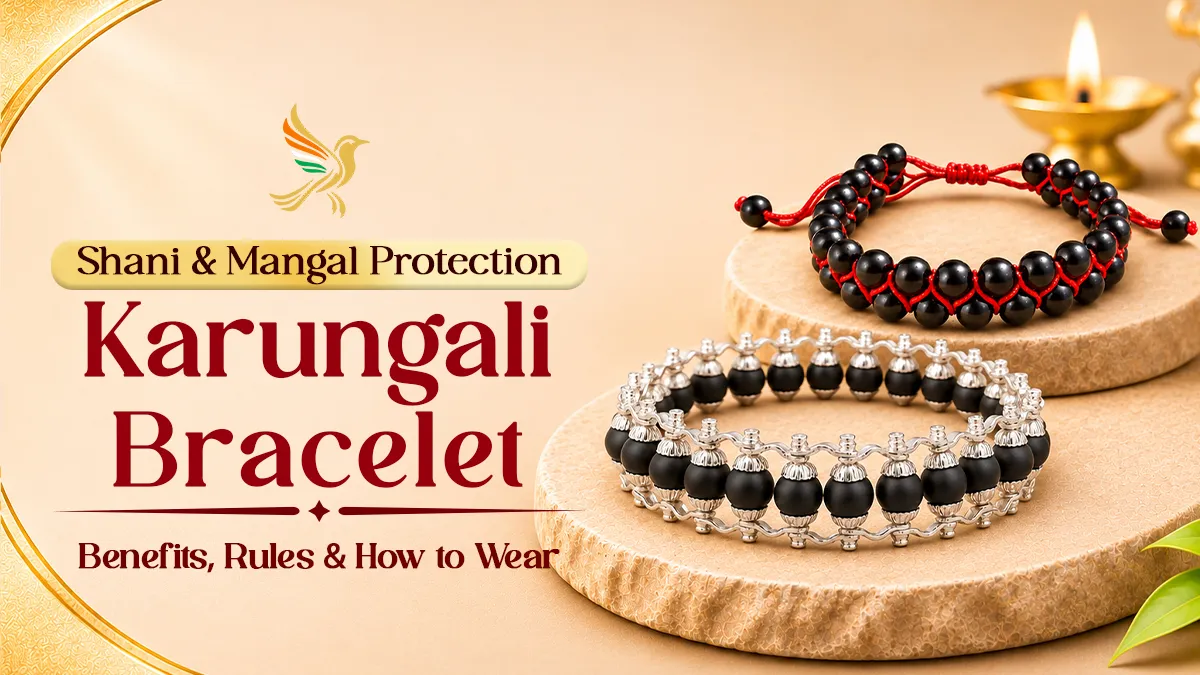
A Karungali bracelet is made from beads of ebony heartwood. It is traditionally worn for protection from negative energy, for support during Shani Sade Sati, and to calm the restless energy of Mangal. People also wear it for courage and a steady mind. Below you'll find every Karungali bracelet benefit, who should wear one, how to wear it, the rules to follow, and how to tell an original from a fake.
What Is Karungali?
Karungali is the Tamil name for ebony – the dense, dark heartwood of the ebony tree. The tree grows very slowly, and only the inner core turns jet black. That core is cut, shaped and polished into the round beads you see in a Karungali malai or bracelet.
In South India, Karungali has been worn for centuries. In Tamil tradition it is linked with Sevvai (Mangal / Mars), whose presiding deity is Bhagwan Murugan. Across India it is also worn as a remedy for Shani. Because it is believed to hold negative energy at bay, it is one of the most popular protective beads today.
Karungali Bracelet Benefits
These are the main reasons people wear a Karungali bracelet. They come from faith and tradition, and every wearer's experience is different.
1. Protection from negative energy and nazar
The most common reason to wear Karungali. It is traditionally believed to form a protective shield around the wearer and keep nazar (the evil eye) and negativity away.
2. Support during Shani Sade Sati and Dhaiyya
Sade Sati and Dhaiyya are known as the testing phases of Saturn's transit – delays, pressure and slow results. Many people wear Karungali through these years as a supportive remedy.
3. Calm for Mangal's fiery energy
Mangal is linked with anger, haste and arguments. Karungali is worn to cool that energy and bring a little patience before reacting.
4. Courage and inner strength
Ebony is heavy and solid. Wearers say it helps them feel grounded and fearless, especially on difficult days.
5. A steady mind for work and career
Repeated delays at work, a stuck promotion or a business that won't move are often linked in tradition with Shani and Mangal. Karungali is worn as a daily reminder to keep going with patience.
6. Focus during meditation and jaap
Karungali malas are used for mantra jaap, especially for Shani, Hanuman ji and Murugan mantras. A bracelet keeps that energy with you through the day.
Want a ready-to-wear option? Our Karungali Shani Mangal Kawach bracelet and modern karungali bracelet, comes with a certificate of authenticity, and is energised before dispatch.
Who Should Wear a Karungali Bracelet?
People going through Shani Sade Sati or Shani Dhaiyya
People with Mangal Dosh in their kundli
Those born under Mesh (Aries) or Vrishchik (Scorpio), ruled by Mangal, and Makar (Capricorn) or Kumbh (Aquarius), ruled by Shani
Anyone who feels affected by nazar or a long run of bad luck
People who get angry quickly or feel restless and fearful
Anyone who wants a simple protective bead for daily wear – Karungali suits men and women of all ages
If you are wearing it for a specific dosh, it is always best to ask your astrologer first.
How to Wear a Karungali Bracelet
Choose the day. Saturday (Shani's day) is the most common. Tuesday (Mangal's day) also works, especially for Mangal Dosh.
Wear it in the morning after your bath, facing east if you can.
Hold the bracelet in both hands and chant “ॐ शं शनैश्चराय नमः” (Om Sham Shanaishcharaya Namah) 11 times.
Wear it on your left hand. In tradition, the left is the receiving hand.
Recharge it every 15 days – rest it overnight on a selenite plate or in full-moon light on Purnima.
Karungali Bracelet Rules: When to Take It Off
Karungali is natural wood, so most rules are about keeping it dry and clean:
Take it off before you bathe, swim or work out. Water and sweat dull the beads.
Remove it before you sleep, and rest it on the selenite plate overnight.
Keep it away from perfume, soap and chemicals.
Don't lend your Karungali to others. It is a personal piece.
Wipe it with a soft, dry cloth once a week.
Some families also remove it while eating non-vegetarian food or drinking alcohol. Follow what your family tradition or astrologer says.
Karungali Bracelet vs Karungali Malai
| Karungali bracelet | Karungali malai (mala) | |
| Worn on | Wrist | Neck, or used for jaap |
| Best for | Daily wear, office, travel | Mantra jaap, puja, temple visits |
| Beads | Usually 8–10 mm, 1–2 rows | 54 or 108 beads |
| Easy to remove | Yes | Less convenient |
For most people, a bracelet is the easiest way to keep Karungali on all day.
Can You Wear Karungali with Rudraksha?
Yes. Both are linked with Bhagwan Shiv and are often worn together. Karungali brings protection and strength; Rudraksha brings calm and peace. Many people choose a bracelet that has both on one chain.
See our Panchmukhi Rudraksha and Karungali bracelet – lab certified, 8 mm, with a free Shree Yantra charging plate.
How to Identify an Original Karungali Bracelet
Fake Karungali is common – painted wood, plastic or dyed beads sold as ebony. Here's how to check:
Weight: Real ebony is dense and feels heavy for its size.
Water test: Genuine Karungali sinks in water. Light wood floats.
Colour and grain: Deep black to dark brown with a faint natural grain. Perfectly even, glossy beads are a red flag.
Cloth test: Rub a bead on a damp white cloth. Real ebony leaves no black colour.
Smell: A faint woody smell. Never plastic or paint.
Certificate: The surest check. Buy from a seller that gives a certificate of authenticity – every Sanatan Sansaar Karungali bracelet comes with one.
Which Karungali Bracelet Should You Buy?
| If you want… | Choose |
| Strong Shani and Mangal protection | Karungali Shani Mangal Kawach (double row) or modern karungali bracelet |
| Protection plus calm and Shiv ji's grace | Panchmukhi Rudraksha & Karungali bracelet |
| To explore all options | All spiritual bracelets |
FAQs
What are the benefits of wearing a Karungali bracelet?
It is traditionally worn for protection from negative energy and nazar, support during Shani Sade Sati and Dhaiyya, calm for Mangal's fiery energy, and courage and a steady mind.
Which hand should I wear a Karungali bracelet on?
Most people wear it on the left hand, which is traditionally the receiving hand.
Which day is best to start wearing Karungali?
Saturday, Shani's day, is the most common. Tuesday also works, especially for Mangal Dosh.
Can women wear a Karungali bracelet?
Yes. Karungali is worn by men and women of all ages.
Can I sleep with my Karungali bracelet on?
It is better to remove it at night and rest it on a selenite plate. This keeps the wood dry and the bracelet recharged.
How do I know if my Karungali is original?
Real Karungali is heavy, sinks in water, has a natural grain and leaves no colour on a damp cloth. A lab report is the surest proof.
Does a Karungali bracelet really work?
Its benefits come from faith and tradition, and they differ from person to person. It is best seen as a spiritual support, not a guarantee.